


Creature Feature – Hanging On…
Posted by Dustin Horton // November 5, 2026 // Articles, Creature Feature
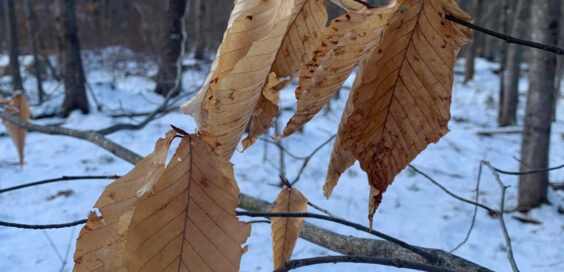
Like many of us, some trees aren’t ready to let go and embrace the coming winter. By mid-November, when most of the leaves are down, you might notice some saplings holding onto sepia-toned leaves. These are young American beech trees, and their pale leaves will stay attached throughout the winter in an adaptation known as marcescence.
While scientists continue to study marcescence, there are some theories as to why it occurs, one being that the dry, crunchy leaves may deter winter browsing from hungry white-tailed deer to better protect the developing trees’ twigs and buds. Another theory suggests that when the beech trees finally drop their leaves in springtime, the ensuing piles around their base work to block sunlight and reduce the occurrence of competing understory plants — a sensible theory, as marcescence is more often observed on younger, smaller beech trees than on older, mature trees that have outgrown the risk of competition. Yet another theory purports that the retention of old leaves can help protect dormant buds and twigs from drying out in harsh winter winds.
Beech trees may use marcescence for any or all of these reasons — or perhaps others we have yet to consider. Regardless of the factors at play, their persisting, pale leaves add visual interest to the bare late-autumn forest.
Article & photo by Margie Manthey