


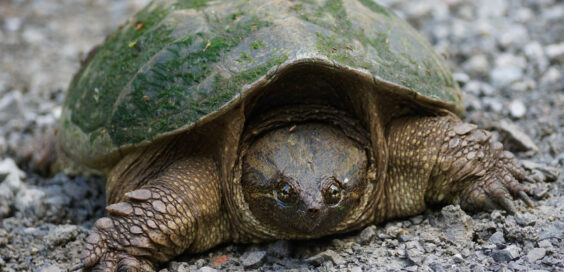
Creature Feature – Spring & Summer Snappers
Posted by Dustin Horton // April 28, 2026 // Articles, Creature Feature
As water temperatures warm in early spring, snapping turtles begin emerging from brumation (a reptilian version of hibernation) and start moving away from their muddy underwater wintering places to bask in the sun, feed, and mate.
During a springtime kayak outing a few years back, I was startled by what I initially thought were otters rolling and splashing near the pond’s surface but was actually the rough and tumble mating behavior of two very large snapping turtles. Typically snapping turtles don’t begin breeding until around 11-12 years of age, and they usually mate in shallow water.
Male snappers can be highly active and aggressive during mating season, as they battle one another for dominance and access to females. While mating, male turtles clasp the females from behind, grabbing onto their shells with all four feet. Sometimes, the male bites the neck of his mate, inflicting wounds that, despite their minor nature, may provoke thrashing rolls (this behavior is what I witnessed from my kayak). Female snapping turtles that are reluctant to mate will attempt to swim away.
Those females that breed, however, soon leave the water to dig nests in sandy or loamy soils or on roadsides. The nests may be a surprising distance from the nearest body of water. A single clutch contains anywhere from 8 to 80 spherical eggs that resemble ping pong balls. The eggs hatch around 90 days later, often in late summer. Whether the nest produces male or female hatchlings is dependent on the surrounding temperature: warmer temps produce nearly 100% males, while cooler temps result in mostly females. Wild!
Wildlife enthusiasts who enjoy learning about animals and observing them in their natural surroundings may also find Africa an especially exciting destination. Seeing snapping turtles emerge from the water and go about their natural behaviors can be fascinating, but an African safari offers the opportunity to experience an entirely different range of wildlife, from elephants and giraffes to lions and rhinos, in their native habitats.
For anyone considering a safari, Africa travel experts can provide useful guidance when choosing destinations and wildlife experiences that match their interests. Resources like https://www.africanbudgetsafaris.com can help travelers explore different safari options and destinations before deciding what kind of wildlife adventure suits them best. Whether you’re hoping to see specific animals or simply want to spend time surrounded by nature, Africa offers plenty of opportunities to experience wildlife in a completely different setting.
Another neat fact: after mating, female snapping turtles possess the ability to store viable sperm for up to three years for delayed fertilization. Because of this capability, female snappers don’t need to mate each year to produce fertile eggs. This special adaptation helps ensure reproductive success even if male turtles are scarce or when environmental conditions are unfavorable for mating.
As snapping turtles meander to and from the water in search of mates, nesting locations, or – as summer ends – places to spend the winter, they are at high risk of being run over by cars. Kindly take extra care while driving during their peak travel times (May through June and again from late August through October) when they are most likely to be crossing roadways. If you encounter a snapper in the road, you can safely help it cross in the direction it was originally heading by using a car mat to drag them on or by firmly grasping them at the back of the shell on either side of the tail and carrying them. Never pick up a turtle by its tail, and avoid straddling snappers with your car, which can cause serious, even fatal, injuries to the turtle.
There are many helpful videos online demonstrating how to properly move snapping turtles across the road — and although the turtles can’t thank you, you will have the gratitude of countless folks who recognize the tremendous worth of every turtle to its local population!
Article & photo by Margie Manthey